25 Dollar Store Home Office Finds for Small Spaces
Working from a corner of the living room teaches you fast that dollar store home office finds are the difference between a desk that works and a pile of stuff with a laptop on top. I set up my own small-space office for under forty pounds using almost everything on this list, and two years on, most of it is still in daily use. These 25 finds are chosen for tight spaces: every one either goes up on the wall, tucks under something, or earns its footprint twice over.
1. Floating Wall Shelves Above the Desk
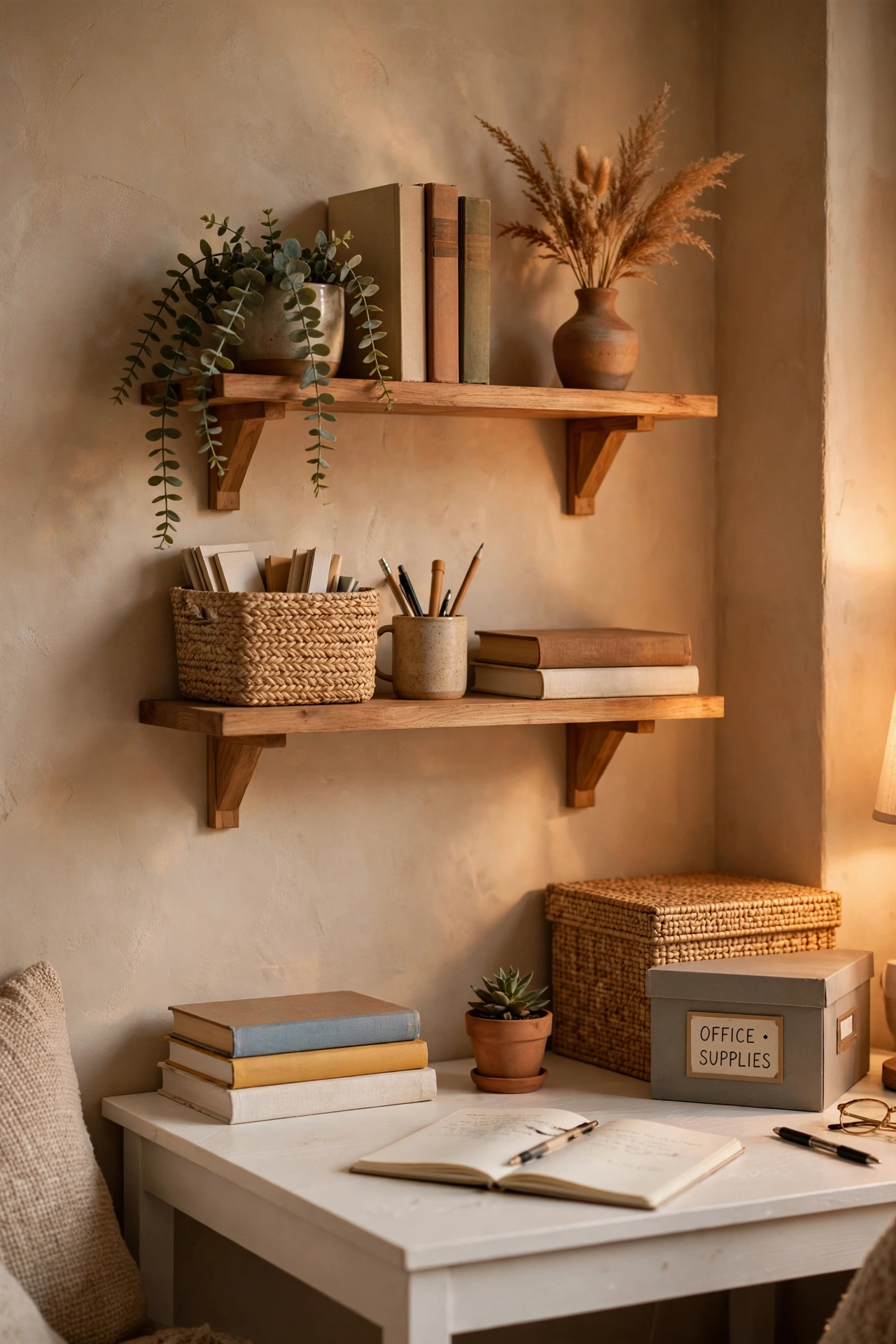
The dollar store’s small floating shelves are perfect for getting reference books and supplies off a crowded desk. Mount two of them above your workspace at eye level, spacing them about 30cm apart so taller items fit below. Keep the heaviest books on the lower shelf and lighter decor up top. I mounted mine slightly off-centre above my desk and it immediately felt like a designed workspace instead of a desk shoved against a wall.
Pro tip: use a proper wall anchor, not just the screw that comes in the packet, if your walls are plasterboard — a shelf of books is heavier than it looks.
Cost: ~$3 each · Time: 30 minutes
2. Cube Storage Bins for Shelving Units
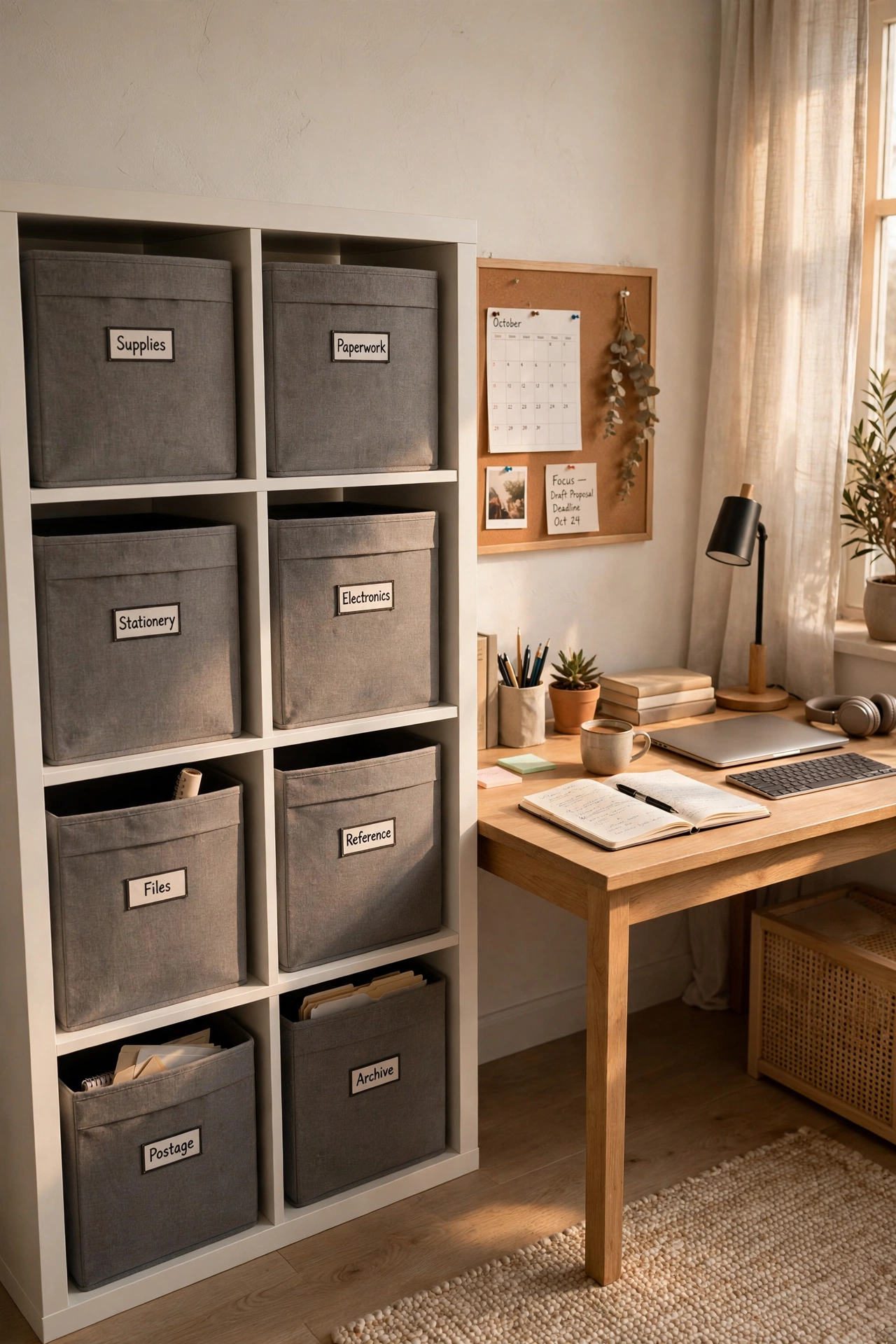
Fabric cube bins turn an open shelving unit into closed storage without buying new furniture. Slide them into each cube, label the front of each one, and assign categories: cables, paperwork, stationery, tech. The trick is to stick to one colour family so the unit reads as a single piece of furniture rather than a patchwork. I use grey bins in my living-room shelving and visitors genuinely don’t realise my printer paper lives in there.
Pro tip: cut a small finger hole in the top back corner of each bin so you can pull it out easily when it’s wedged tight.
Cost: ~$3 each · Time: 20 minutes
3. Stackable Desk Letter Trays
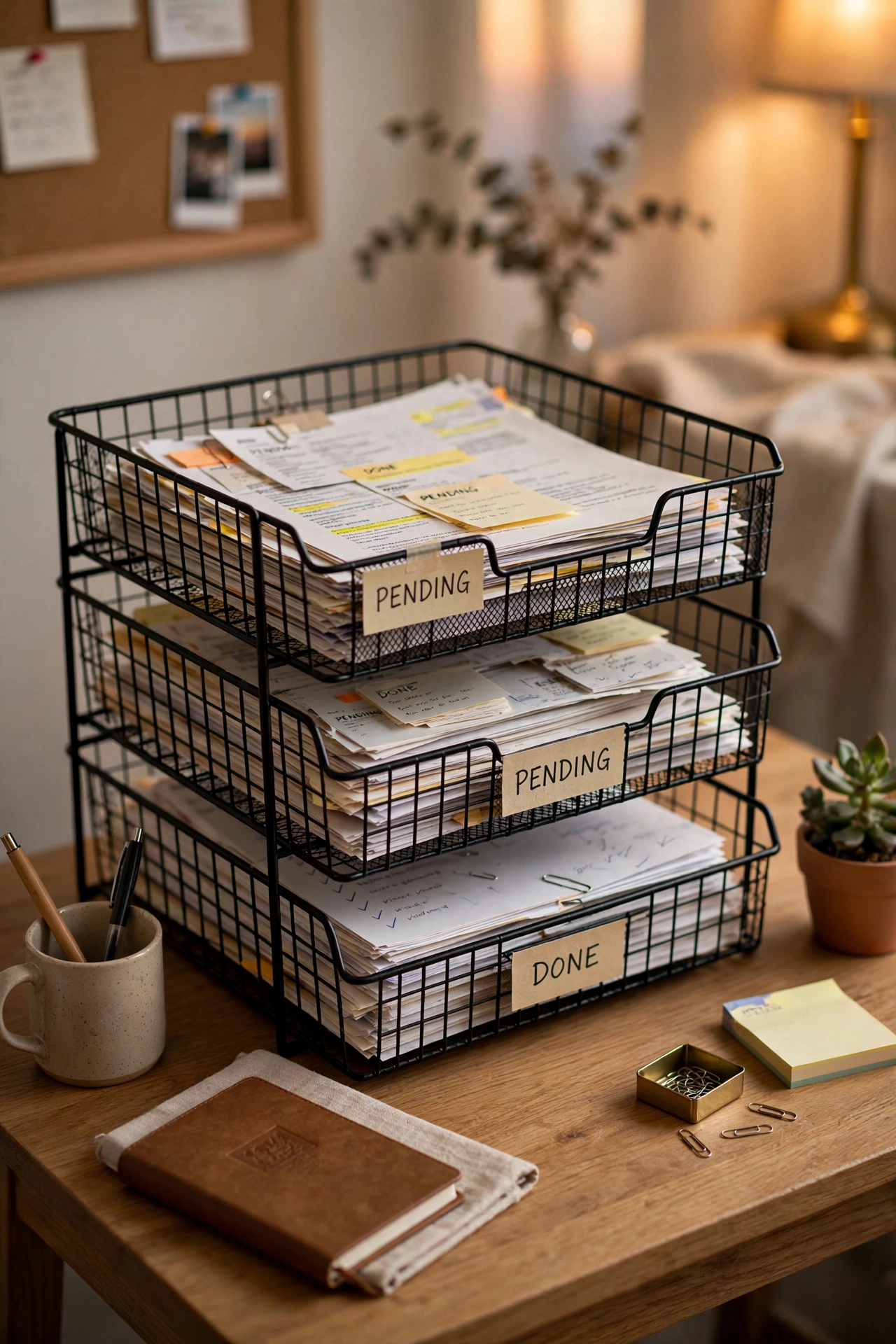
Paper multiplies on a small desk, and a stack of letter trays is the cheapest way to give every sheet a home. Label three trays: in, pending, and done. Sort your paper the day the trays arrive, not “later”, because the system only works if everything starts in the right place. I tried this in my own office and the pending tray became my weekly review pile — Friday afternoons got noticeably calmer.
Pro tip: put the trays to the side of your dominant hand’s reach zone, not directly in front of you, or they’ll eat your keyboard space.
Cost: ~$2 each · Time: 15 minutes
4. Adhesive Cable Management Clips
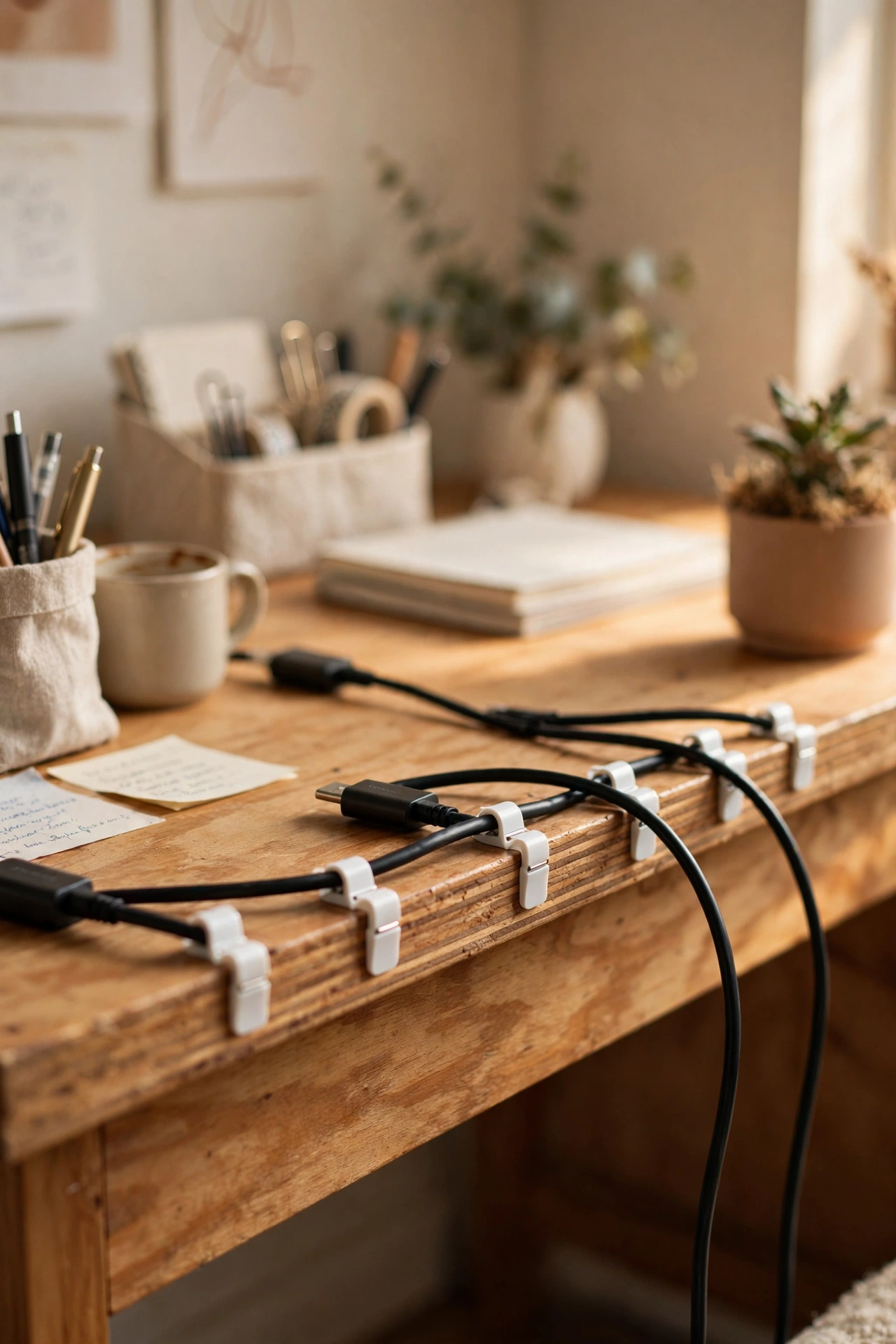
Chargers and cables sliding off the desk is a small-space plague. Stick a row of adhesive cable clips along the back edge of your desk and thread each cable through one. Route the power strip to sit behind a bin or under the desk so only the working ends show. One mistake to avoid: don’t stick the clips to a dusty surface — wipe the edge with a damp cloth first or they’ll peel off within a week, and I learned that the annoying way.
Pro tip: leave one empty clip in the row for the cable you’ll inevitably add next month.
Cost: ~$2 · Time: 10 minutes
5. Rolling Three-Tier Cart
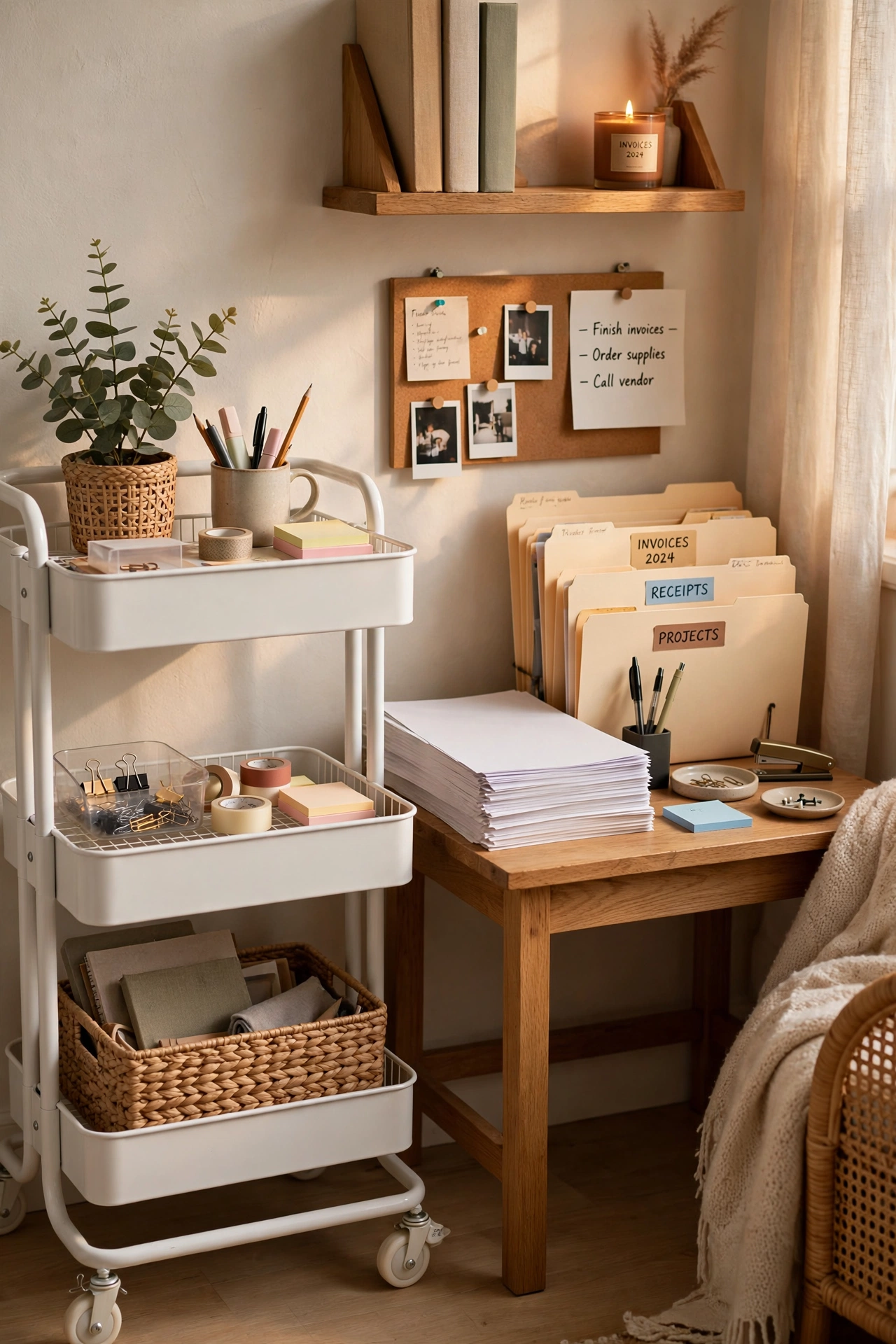
This cart is the small-space office hero: printer supplies on top, active projects in the middle, reference material at the bottom, all on wheels. Roll it beside the desk while you work and tuck it into a cupboard or beside the sofa when you’re done. Assemble it fully before loading — the tiers click in much more easily when the frame is empty. I keep mine loaded and roll it into the hallway every evening; the room goes from office to living room in ten seconds.
Pro tip: add small bins or cups to each tier so items don’t slide around when you wheel it.
Cost: ~$5 · Time: 20 minutes
6. Magazine Holders as File Sorters
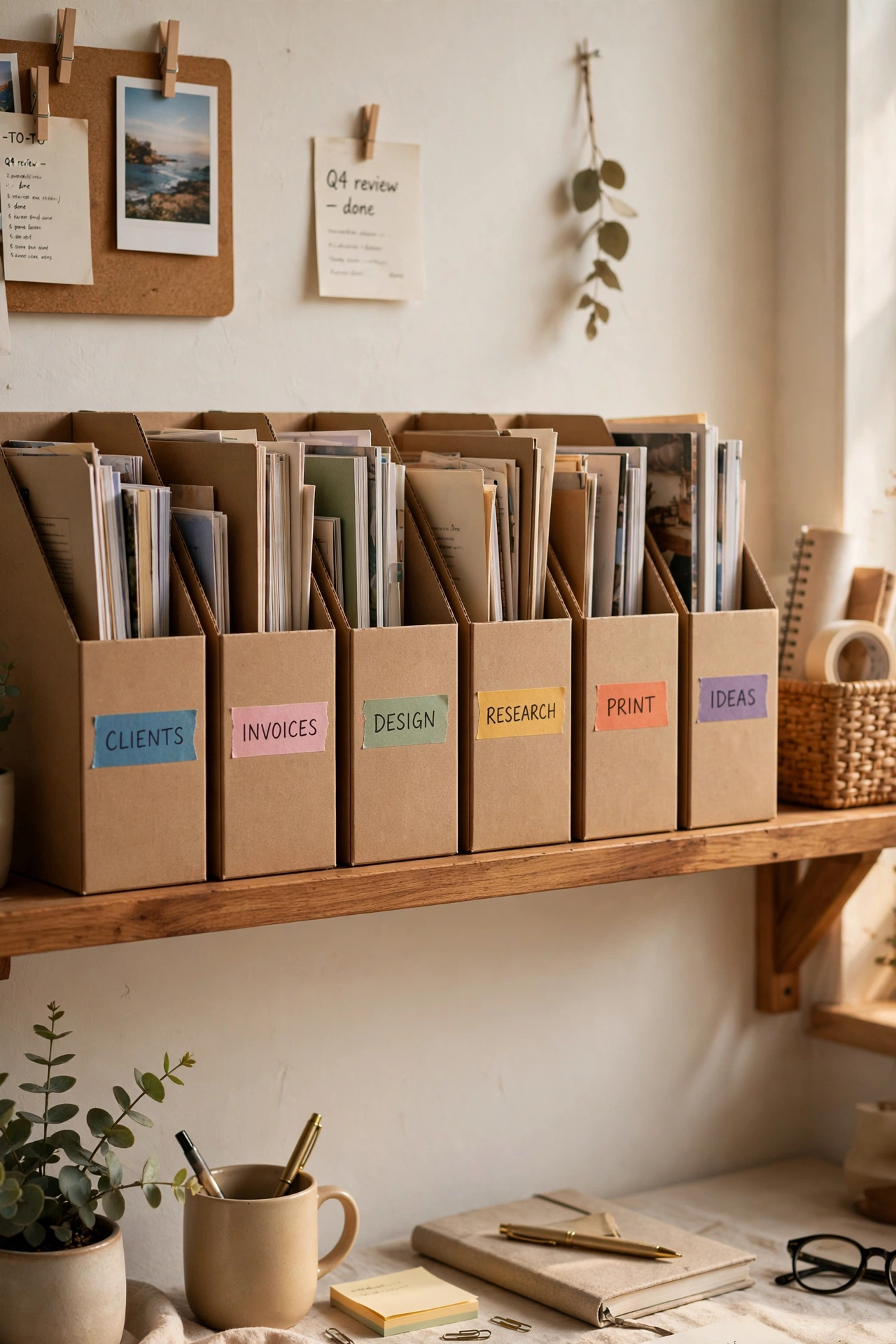
Upright magazine holders make excellent file sorters for active projects, one holder per project. Stand them on a shelf or in a cube bin, label the spine of each, and file papers vertically so you can see every tab. I colour-code mine with a strip of tape on the spine — red for urgent, blue for ongoing. The system works because nothing gets buried; the mistake I made first was buying too few and cramming two projects into one holder, which defeated the whole point.
Pro tip: keep a “to file” holder as well, and empty it weekly, or it becomes a second junk drawer.
Cost: ~$2 each · Time: 15 minutes
7. Matching Pen and Supply Cups
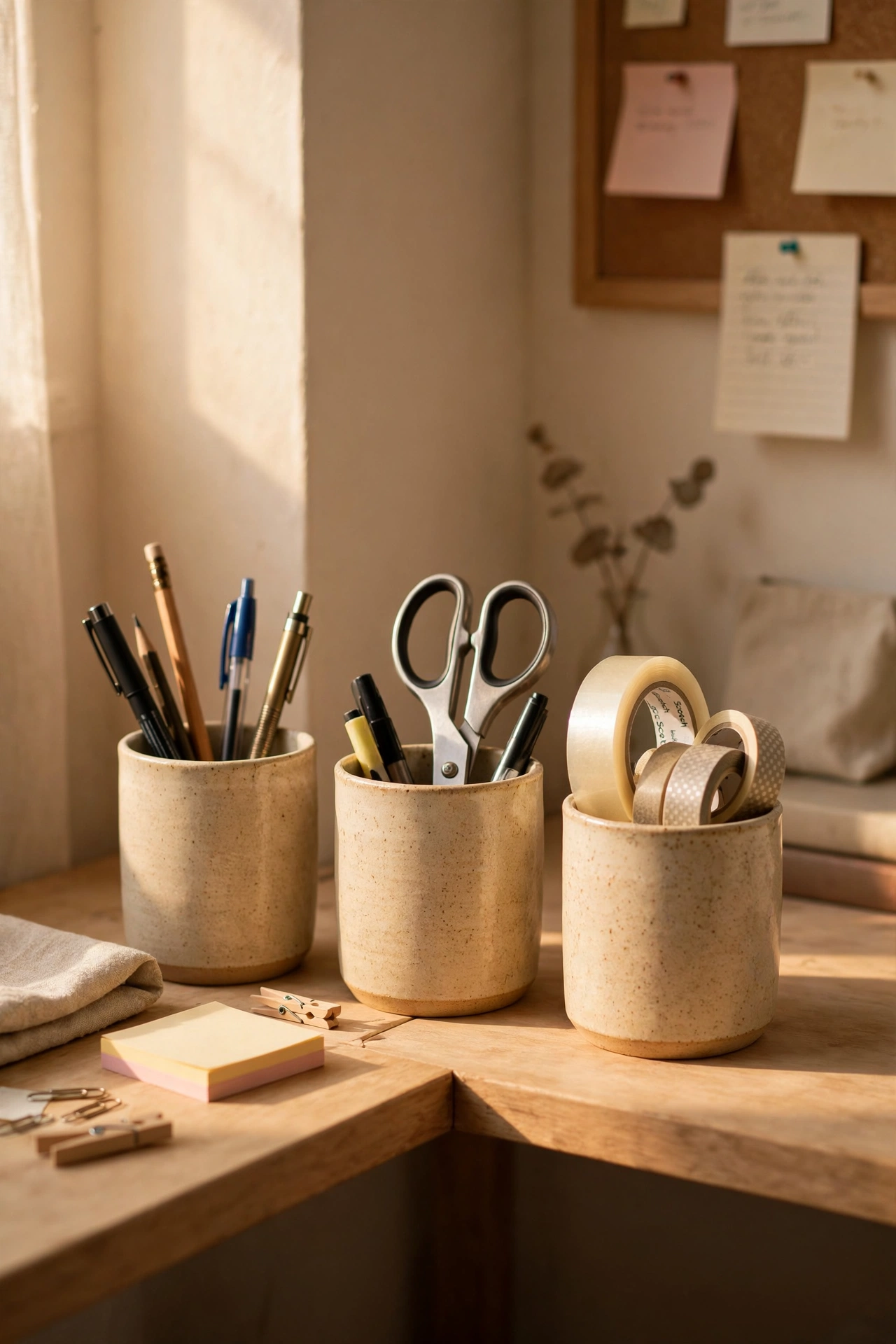
Three matching cups — pens, scissors and tape, odds and ends — look like a deliberate desk set for a few pounds. Group them at the back corner of the desk so they don’t eat writing space, and be ruthless about what goes in: if you haven’t used a pen in a month, it doesn’t earn a cup slot. I swapped a drawerful of dried-out pens for one cup of working ones and my desk finally had room for actual work.
Pro tip: put a small heavy object, like a few coins, in the bottom of a lightweight cup so it doesn’t tip when you grab a pen.
Cost: ~$1 each · Time: 10 minutes
8. Mini Dry-Erase Board for Daily Tasks
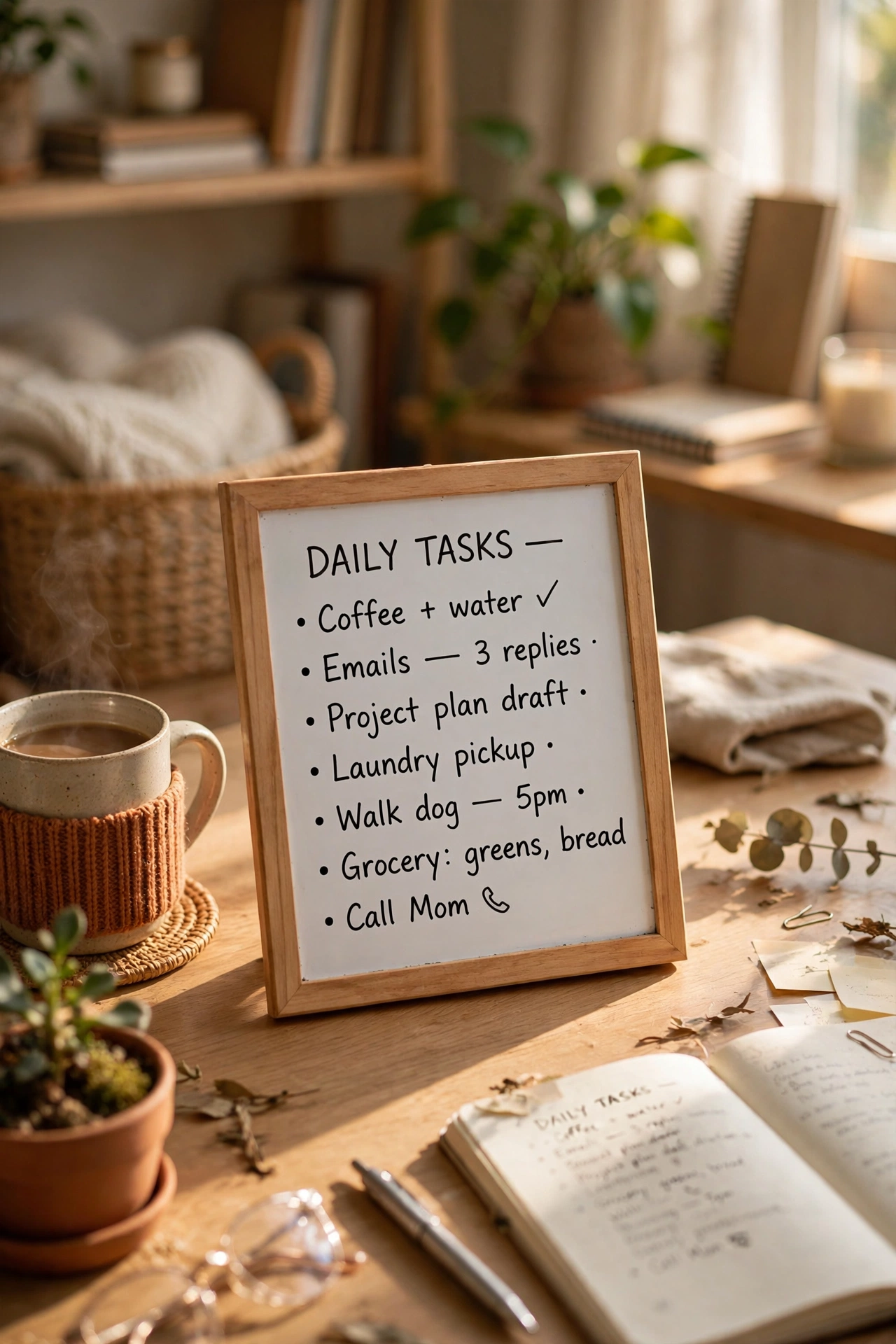
A small dry-erase board propped on the desk or hung on the wall is a daily task list you can’t lose. Write today’s three priorities each morning and wipe them off as you finish — the physical act of wiping feels surprisingly satisfying. Hang it where you see it when you sit down, not behind you. I tried this after years of phone reminders I kept swiping away, and the board worked because it was just… there, staring at me. (see also: 25-dollar-store-mirror-decor-ideas-that-look-pricey)
Pro tip: use fine-tip markers, not the chunky ones, so a small board still holds a useful list.
Cost: ~$2 · Time: 5 minutes
9. Framed Cork Board for Pinning Ideas
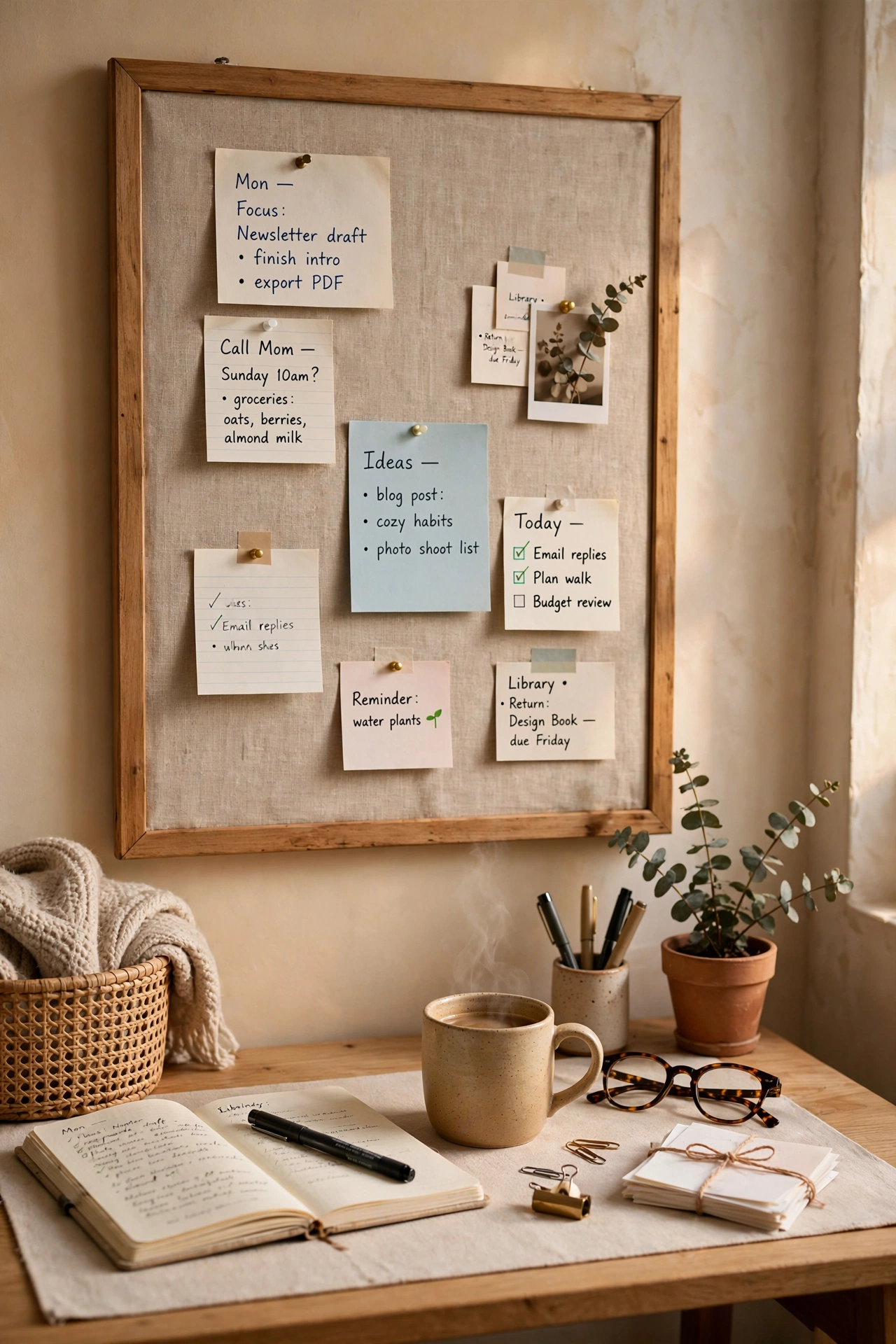
A framed cork board above the desk holds receipts, reference cards, and ideas without a single thing touching the desk surface. Cover the cork with a piece of neutral fabric before you hang it and it looks like a proper notice board instead of an office leftover. Pin things in loose groups rather than neat rows — it should feel like a working board, not a display. One mistake to avoid: don’t hang it where your chair back hits it every time you stand up. I speak from a dented frame.
Pro tip: use flat-head pins so papers sit flush and don’t curl off the board.
Cost: ~$4 · Time: 15 minutes
10. Wall Calendar for Big-Picture Planning
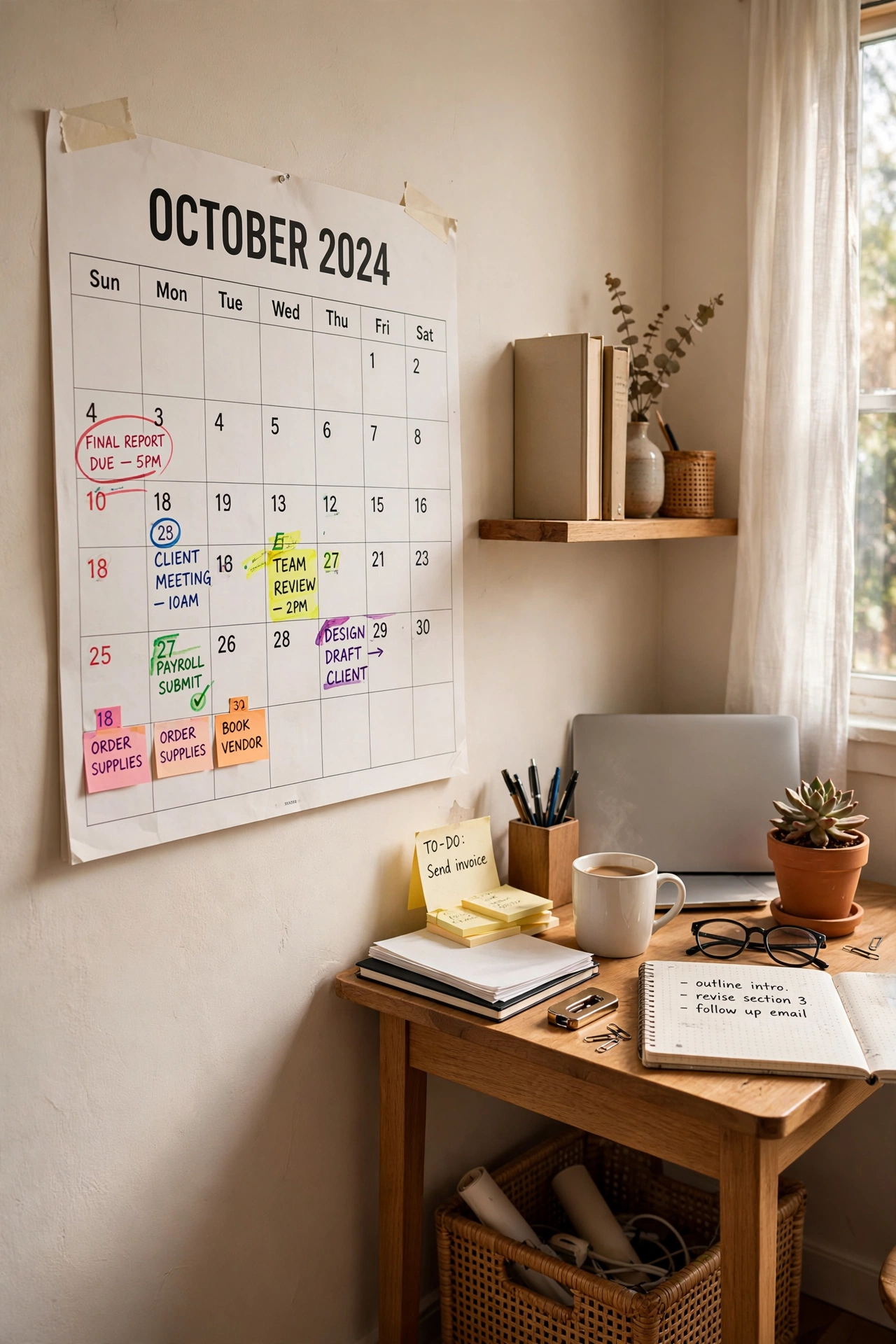
A paper wall calendar gives you the month at a glance in a way no phone screen does. Hang it where you see it from the desk, mark deadlines in one colour and personal commitments in another, and review it every Monday morning. I keep mine next to the cork board and the two together act as my office’s mission control. Buy the large-format one — the small calendars are unreadable from more than a metre away, which I discovered after squinting for a month.
Pro tip: photograph each month’s page on your phone so the dates survive even if the calendar doesn’t.
Cost: ~$2 · Time: 5 minutes
11. Compact Desk Lamp
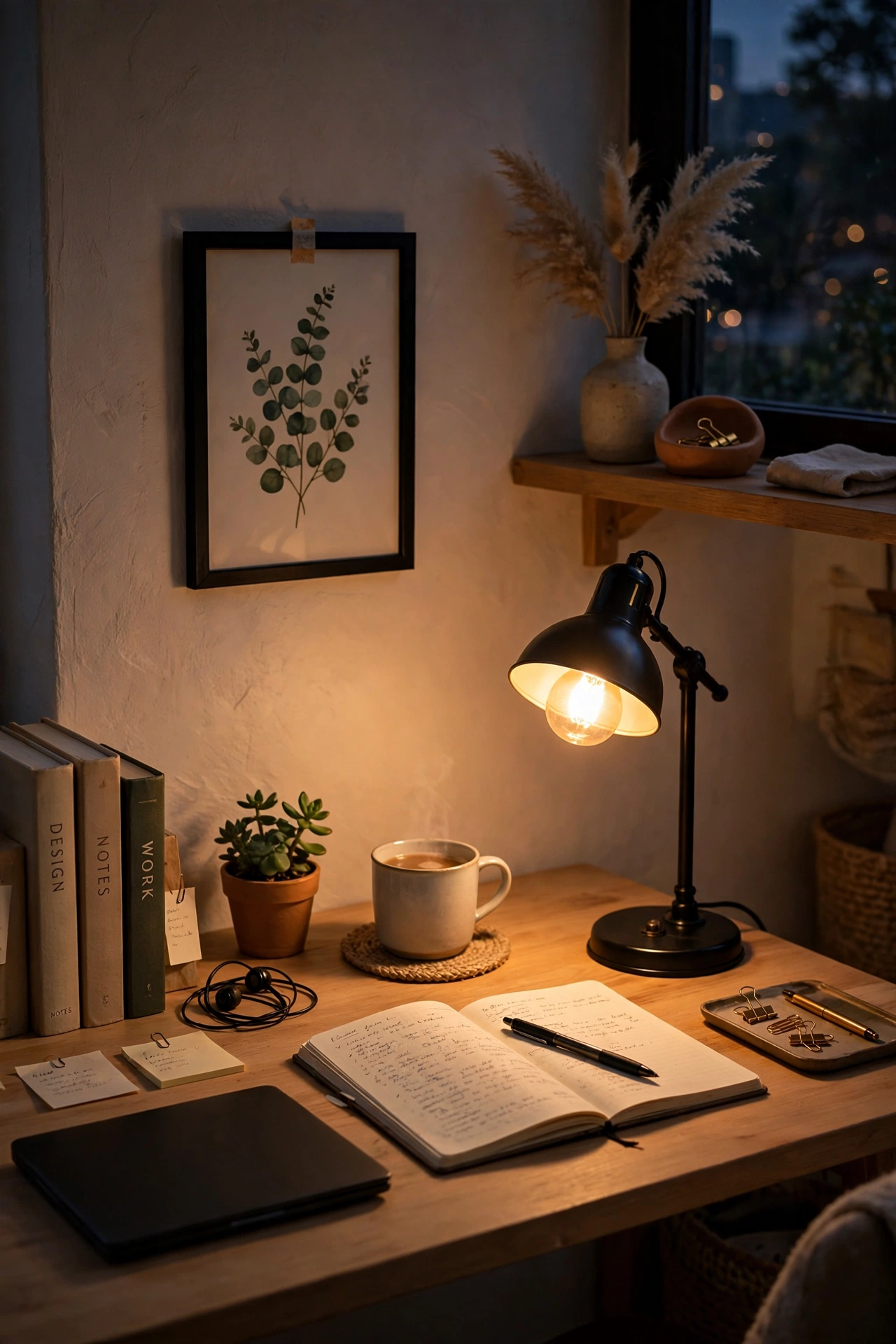
Good task lighting matters more in a small space because you’re often working in a corner away from the main light. A compact lamp with a warm bulb aimed at the work area reduces eye strain and makes evening work feel cosy rather than grim. Position it on the opposite side from your writing hand to avoid shadows. I tried working under just the ceiling light for a year and wondered why my eyes ached by six; a five-pound lamp fixed it in a day.
Pro tip: choose a warm-white bulb (around 2700K) — cool daylight bulbs feel clinical in a living-room office.
Cost: ~$5 · Time: 5 minutes
12. Laptop Riser Stand
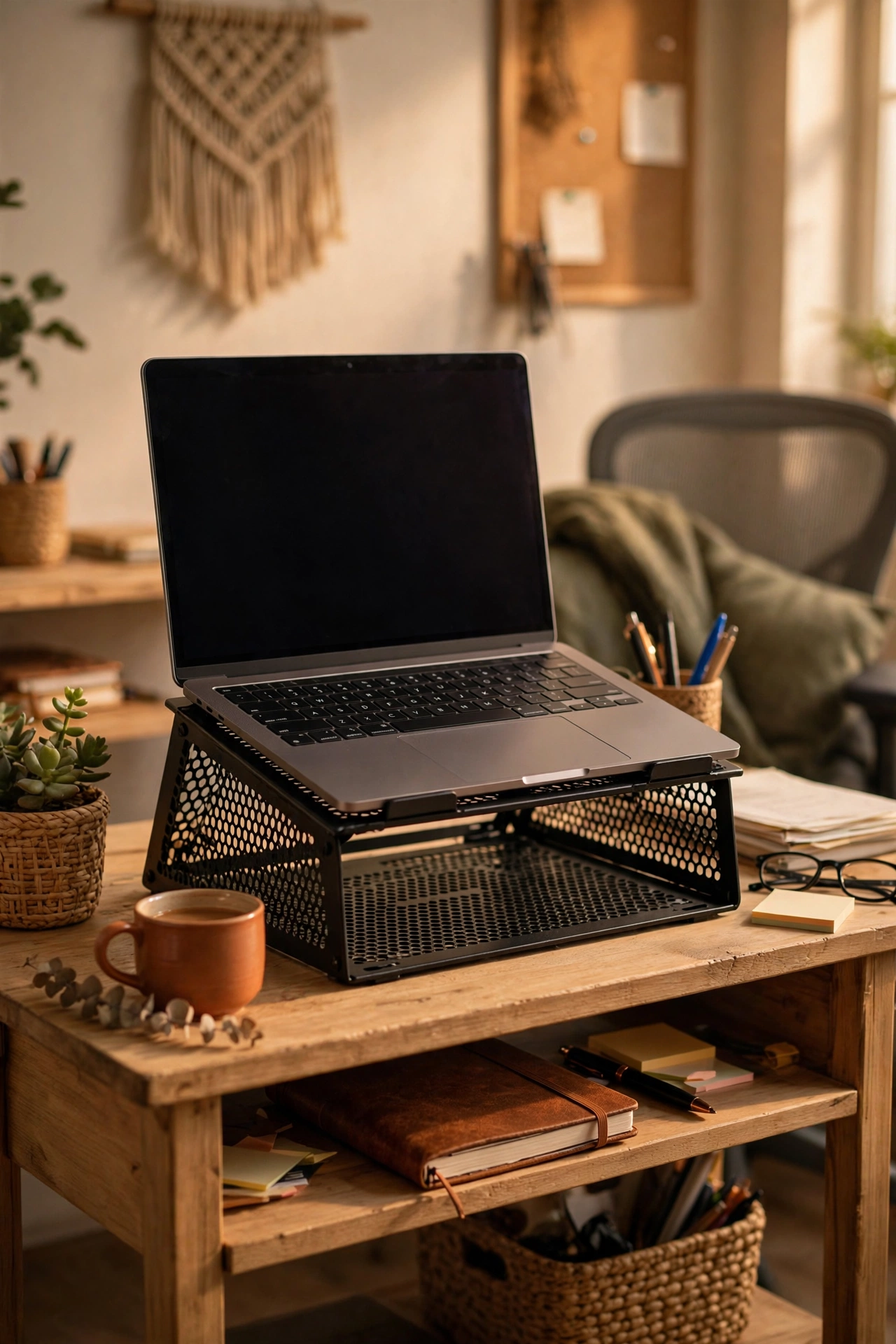
A simple riser lifts your laptop screen to eye level and the space underneath becomes storage for a notebook or keyboard. Pair it with a separate keyboard and mouse and your posture transforms overnight. I resisted this for ages thinking my setup was fine, then tried one and my neck thanked me within days. Look for a riser with ventilation holes if your laptop runs hot — solid ones can trap heat. (see also: 21-dollar-tree-home-office-decor-hacks-that-look-high-end)
Pro tip: the top of the screen should sit at or just below eye level; stack books under the riser temporarily to find your height before committing.
Cost: ~$4 · Time: 5 minutes
13. Hanging Wall Pockets for Paper
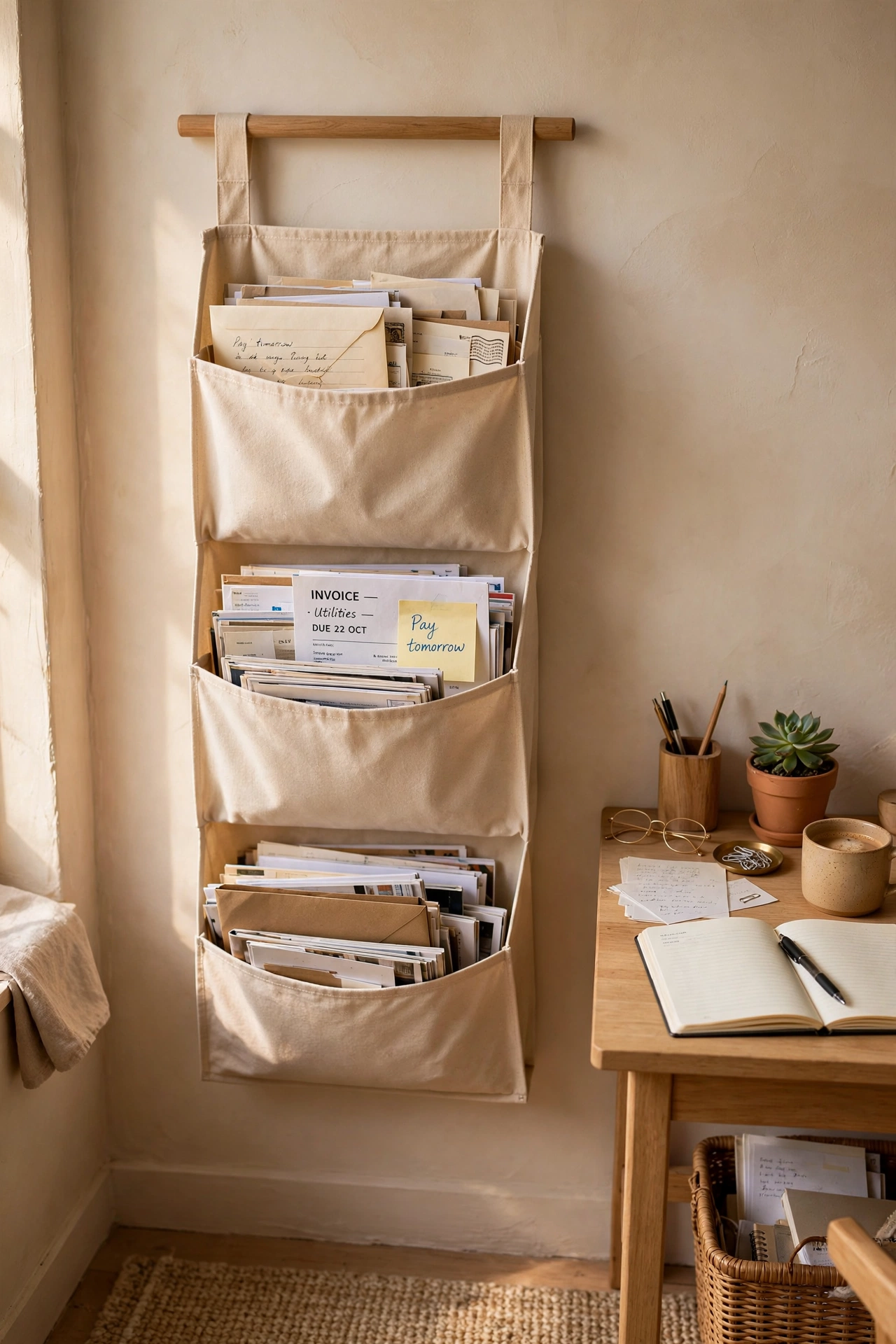
Fabric wall pockets hung beside the desk swallow incoming paper before it lands on the worktop. Sort by household, work, and action-needed as post comes in. This is the single habit that kept my small desk clear: paper goes in a pocket or in the bin, never on the desk. I mounted mine on the side of a bookcase since my wall space was taken, which worked just as well. Empty the action pocket weekly or it becomes a vertical junk drawer.
Pro tip: hang them at standing height so you can file without sitting down — you’ll actually use them.
Cost: ~$3 · Time: 15 minutes
14. Wooden Bookends for Reference Shelf
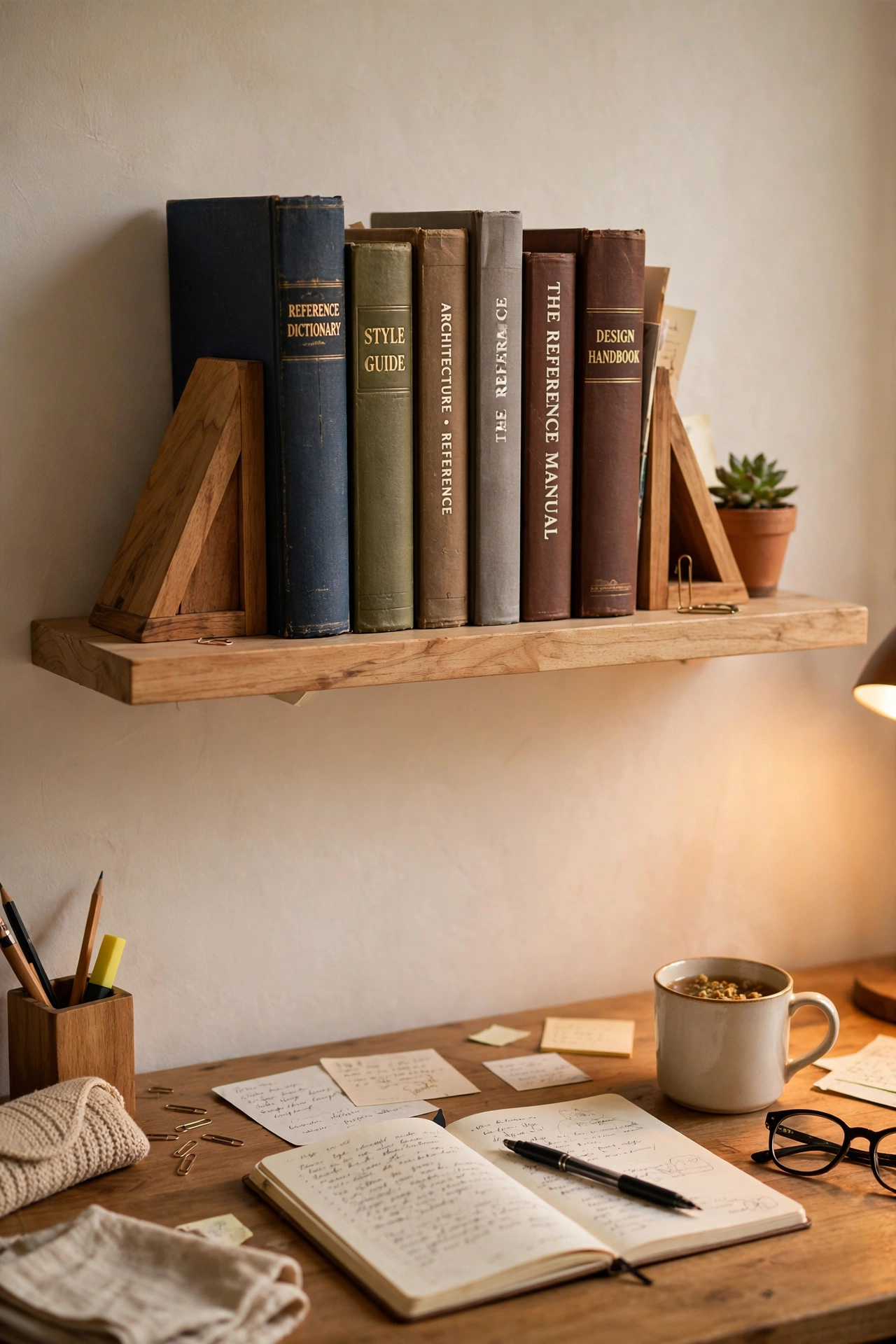
A pair of simple bookends keeps reference books upright on a floating shelf without a bookcase. Place them with books packed snugly between — bookends fail when there’s too much slack. I use mine to hold the half-dozen books I actually reference, and the rest live elsewhere; a small office forces you to keep only what you use, which is honestly a gift. Choose heavy-feeling ones over the flimsy metal L-shapes, which slide.
Pro tip: put a small square of non-slip shelf liner under each bookend for extra grip on smooth shelves.
Cost: ~$2 · Time: 5 minutes
15. Sticky Notes and Page Flags Set
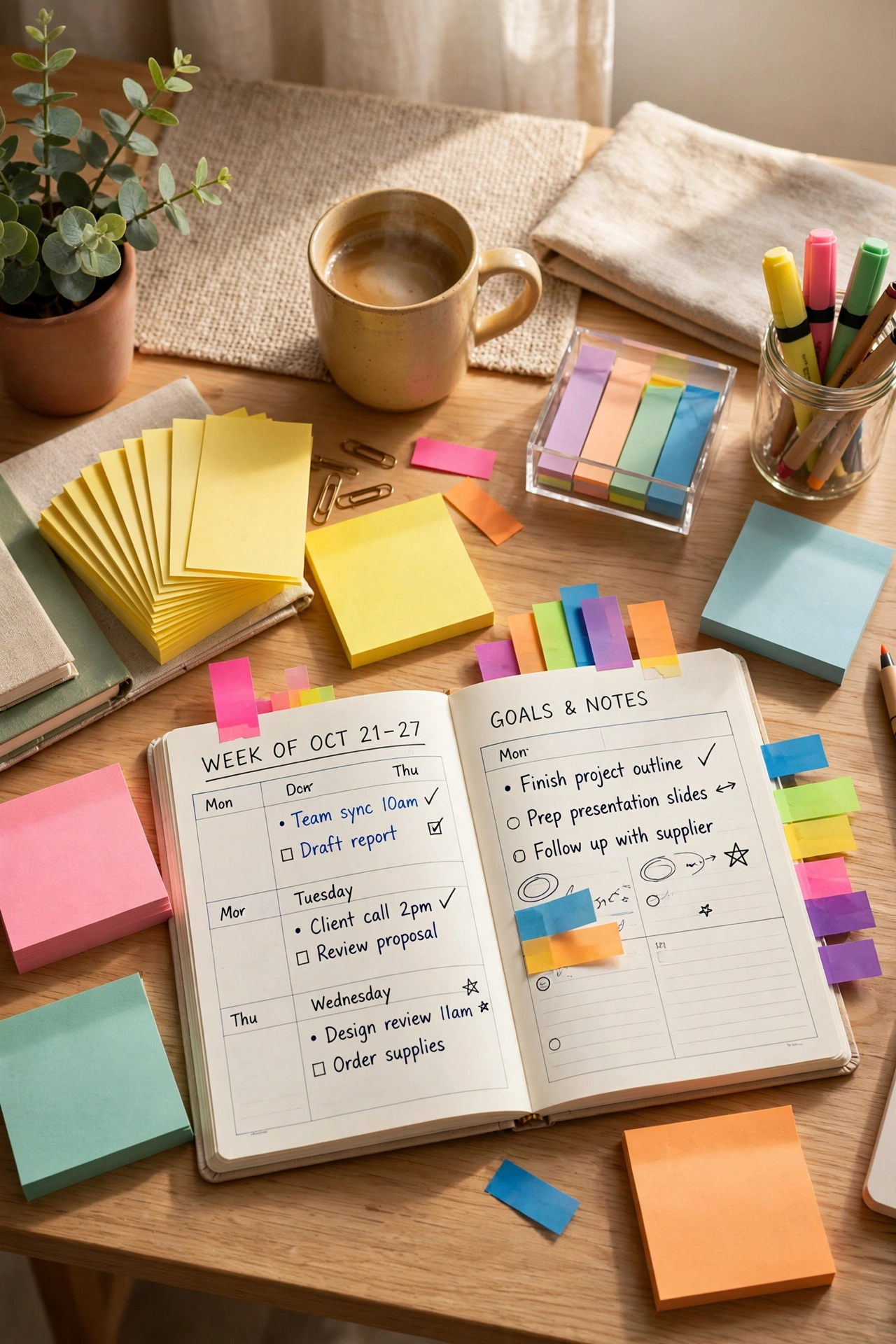
Bulk packs of sticky notes and page flags cost pennies at the dollar store and power the whole paper workflow: flagging, reminding, bookmarking. Keep one pad on the desk and the spares in a drawer — I keep a pad in every room because ideas don’t wait for me to walk to the desk. One mistake to avoid: the ultra-cheap notes sometimes don’t stick to textured walls, so test one before you cover the fridge in reminders that fall off by Tuesday.
Pro tip: write the date on time-sensitive notes so a stray one on the floor still makes sense a week later.
Cost: ~$2 · Time: 5 minutes
16. Washi Tape for Colour-Coding
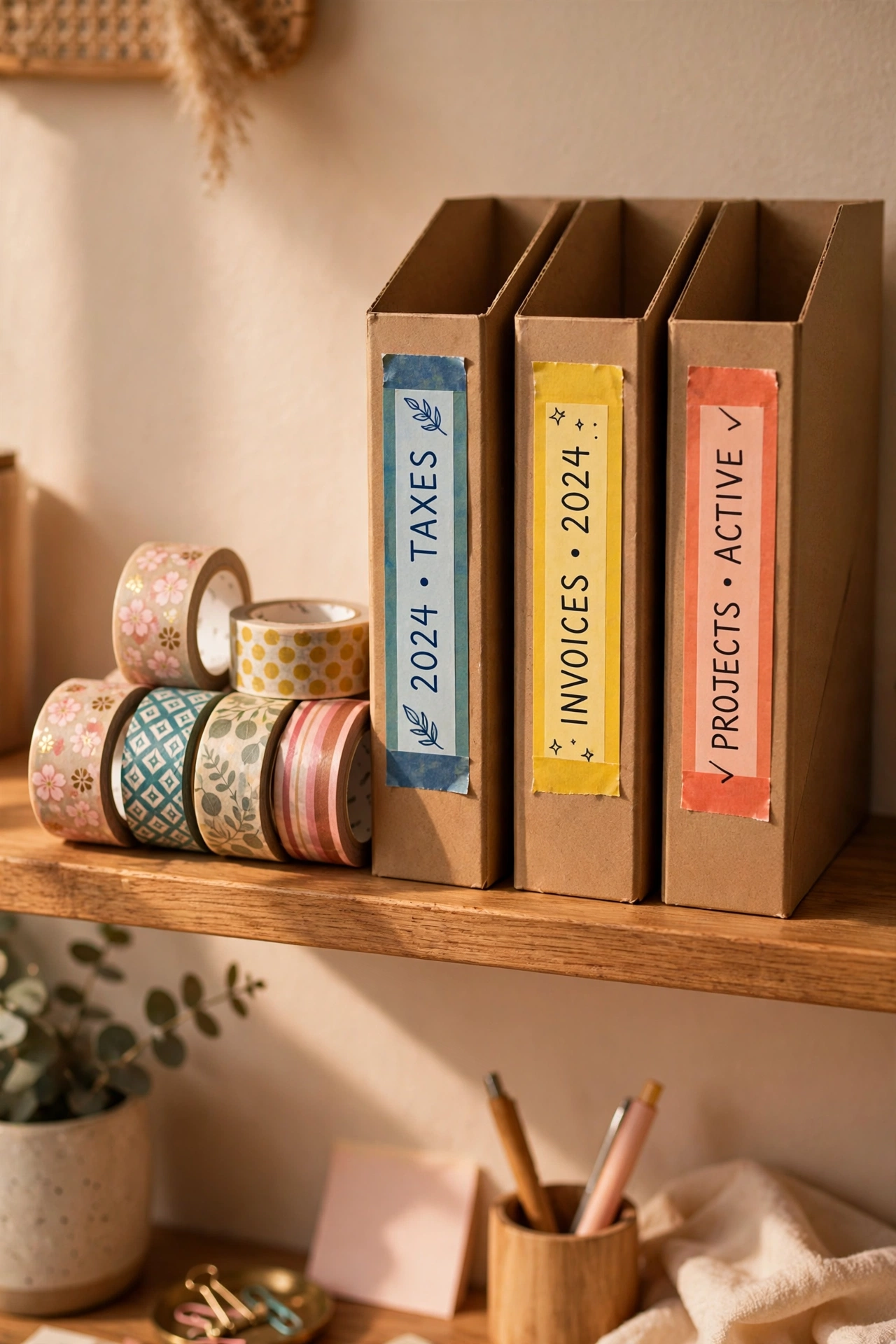
A few rolls of washi tape turn labelling into something you might actually enjoy. Tape a strip on each file holder spine, mark cable ends, seal envelopes, label storage boxes. It peels off cleanly, which matters in a rented space. I colour-coded my entire filing system with three rolls and could find any project in seconds.
Pro tip: wrap a strip around each end of similar-looking chargers so you grab the right one first time.
Cost: ~$2 · Time: 10 minutes
17. Self-Adhesive Labels and a Marker
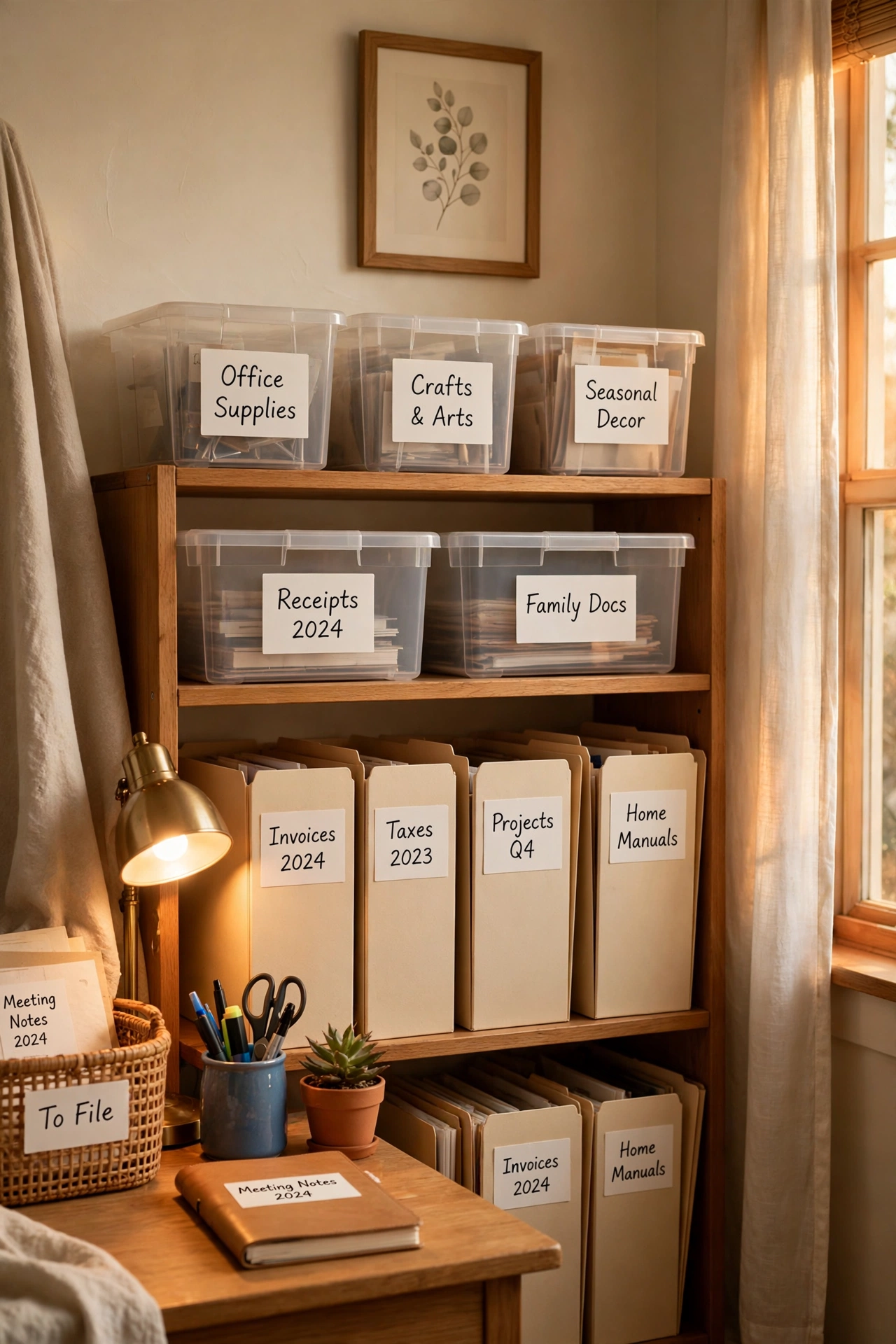
Plain white labels and a thick marker are the unglamorous backbone of an organised office. Label bins, folders, drawers and shelves on the day you set them up — an unlabelled system decays within a month because nobody else in the house knows the rules. I labelled everything in my office in one Sunday afternoon and the maintenance since has been nearly zero. Write in block capitals; your future self reading a label at arm’s length will thank you.
Pro tip: date perishable labels like “tax 2026” so old categories get retired instead of lingering.
Cost: ~$2 · Time: 30 minutes
18. Under-Desk Hanging Drawer
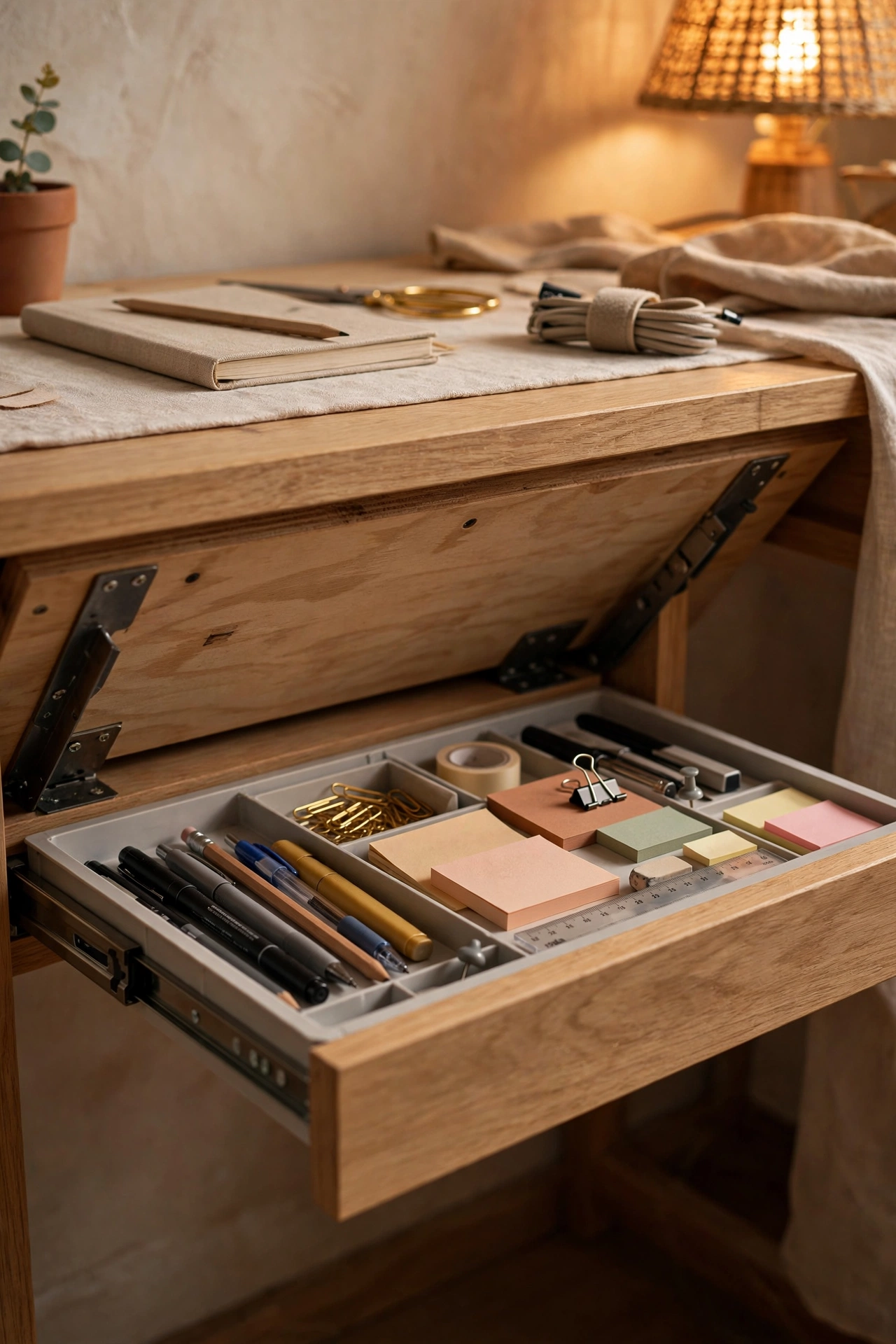
A drawer that slides under the desktop on brackets adds storage to a desk with none, no legs or floor space required. Mount it under the side you don’t kick, load it with stationery and small tech, and keep the top of the desk clear. I added one to a simple table-desk and it felt like upgrading to a proper office desk. Check the weight rating before you fill it with a printer — most are fine for light supplies but not for heavy kit.
Pro tip: mount it slightly back from the front edge so your knees never meet it.
Cost: ~$5 · Time: 20 minutes
19. Charging Tray for Devices
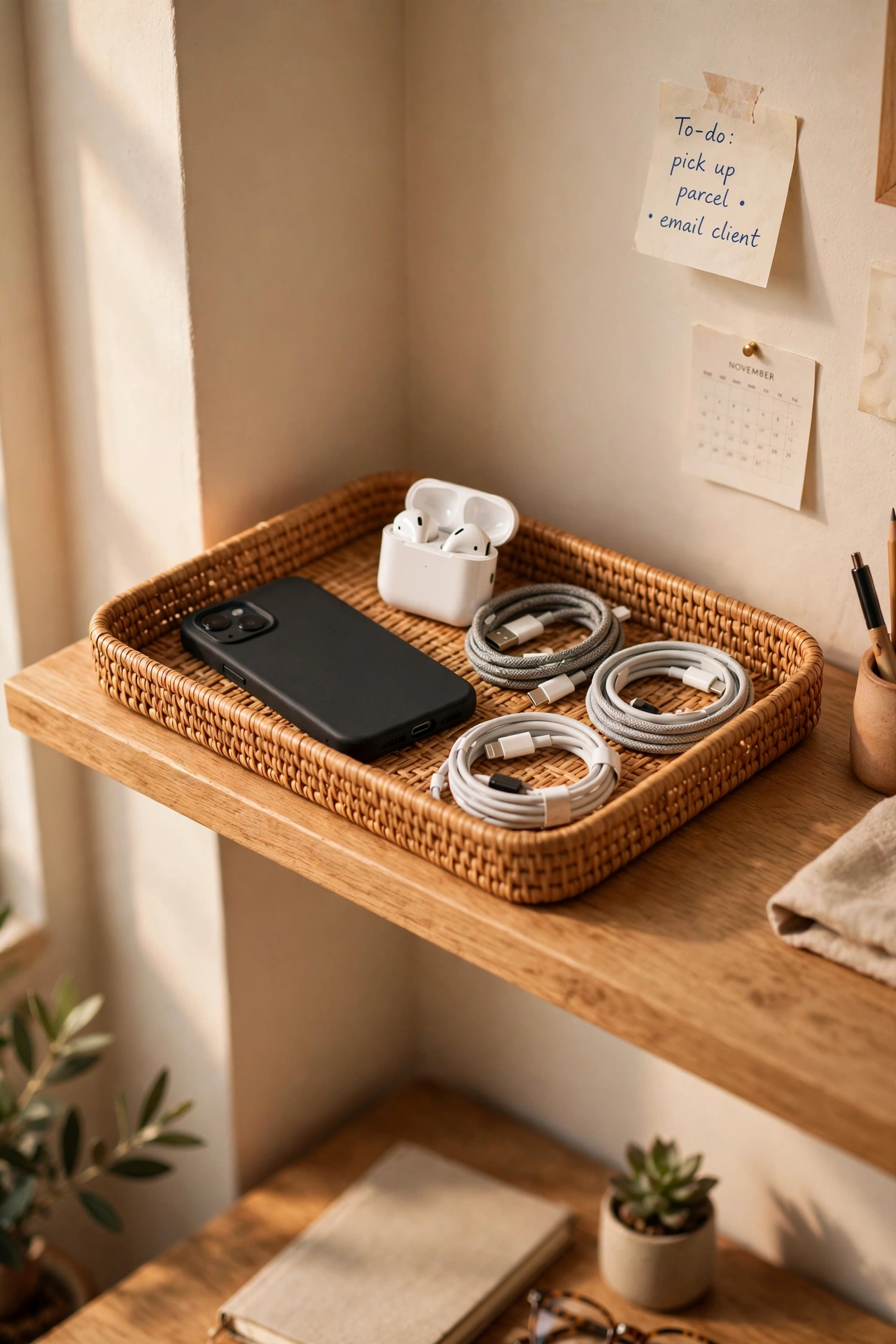
A shallow tray on a shelf or desk corner becomes the designated home for phones, earbuds and chargers. Run one multi-cable through the back, coil the excess with a twist tie, and every device has a parking spot. This ended the nightly hunt for my earbuds, which had become a genuine source of household tension. I tried this in my own setup and the rule is simple: if it’s not in the tray, it’s lost — the tray makes the rule visible.
Pro tip: label each cable end with washi tape so guests can borrow a charger without unplugging yours.
Cost: ~$2 · Time: 10 minutes
20. Document Envelopes for Loose Papers
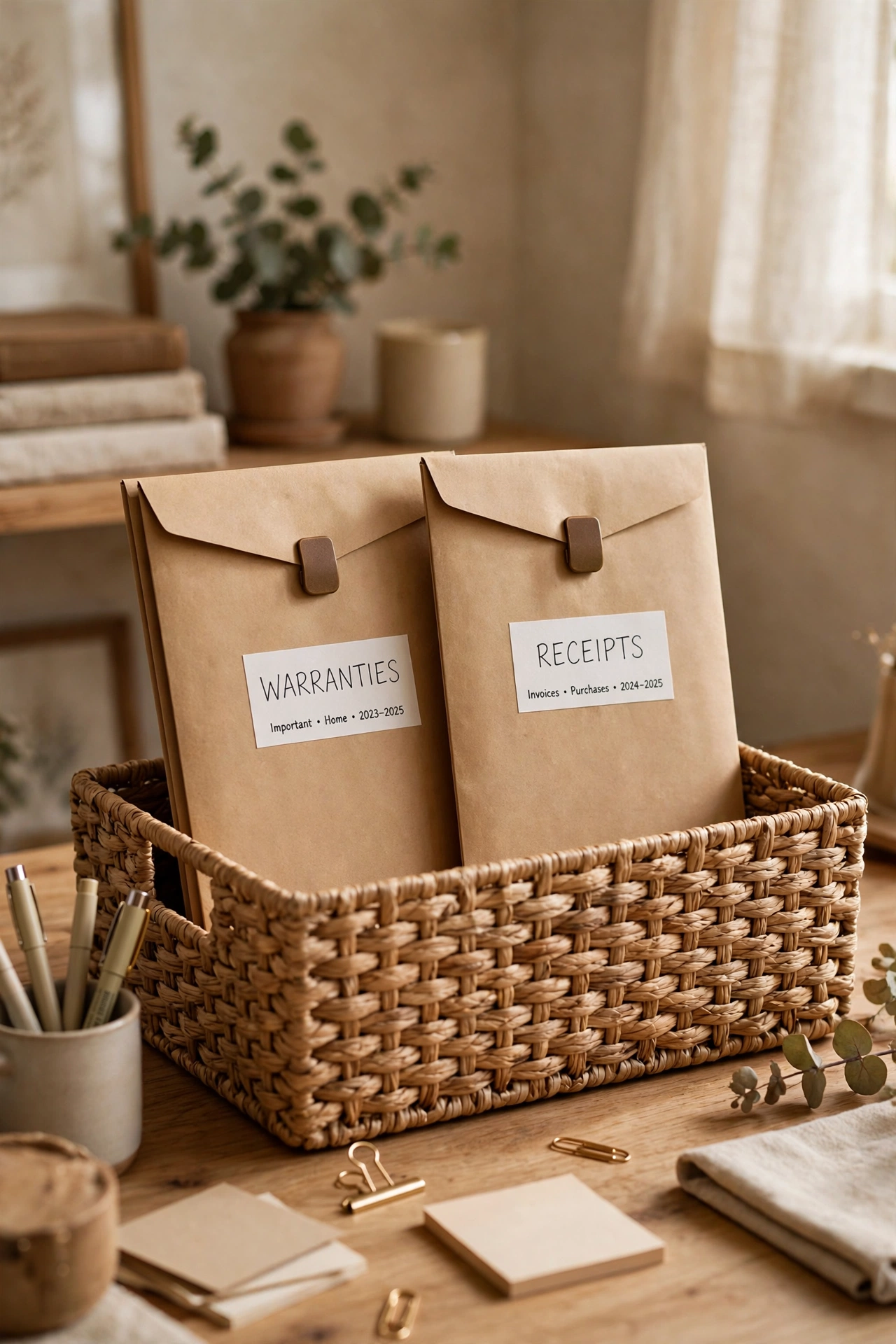
Sturdy document envelopes with a clasp hold the awkward papers that don’t fit files: receipts, warranties, certificates. One envelope per category, stored upright in a bin or holder, and labelled on the front. I keep one for each appliance warranty and it’s saved me twice when something broke and I needed the paperwork. The clasp matters — open envelopes shed papers the moment you move them, which I learned during a house move I’d rather forget.
Pro tip: photograph the contents of each envelope once a year as a backup.
Cost: ~$2 · Time: 15 minutes
21. Mini Desktop Bin
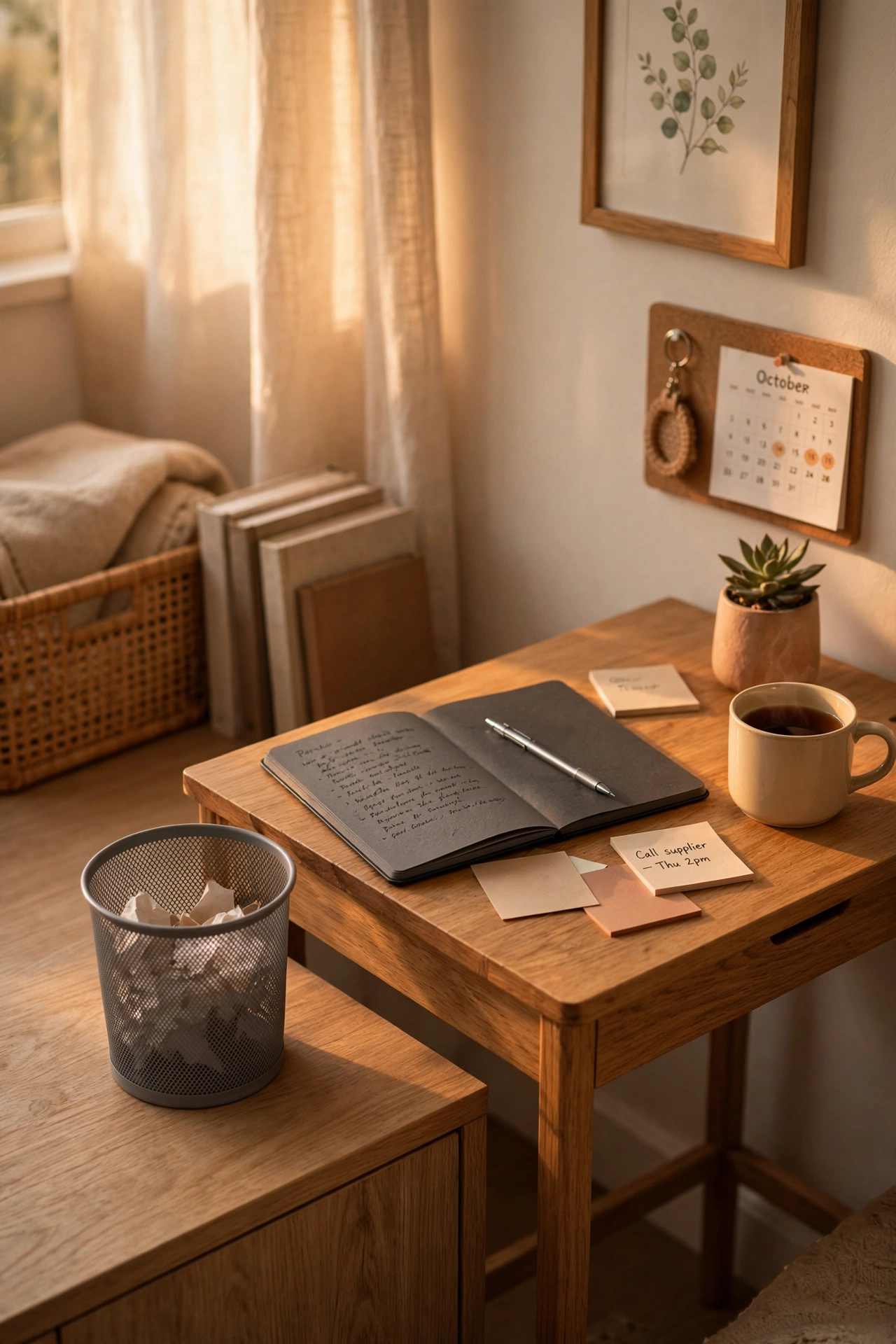
A small bin on or beside the desk catches the daily paper scraps, envelope windows and failed sticky notes before they colonise the worktop. Empty it into the main bin weekly. It sounds trivial, but a desk without a nearby bin slowly becomes the bin. I put one under my desk on the right side and the difference in desk tidiness was immediate. Choose one that fits under the desk so it doesn’t eat floor space you don’t have.
Pro tip: line it with a small bag so emptying takes five seconds, not a shake-and-chase.
Cost: ~$2 · Time: 5 minutes
22. Expandable Drawer Dividers
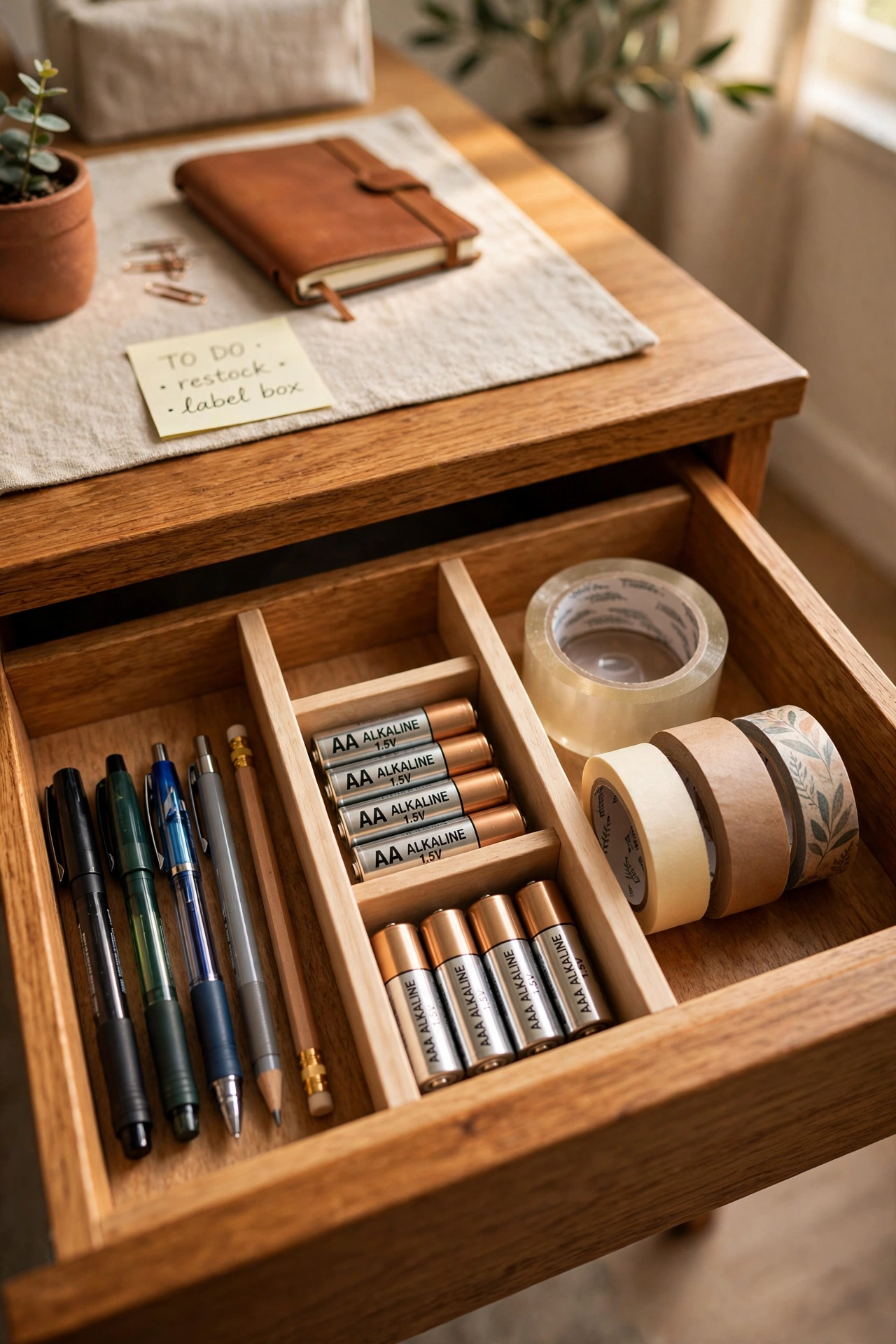
If your desk has even one drawer, dividers turn it from a junk drawer into proper storage. Expand them to fit, then assign zones: pens, batteries, tape, tools. Pull everything out first and only put back what belongs in an office — I found takeaway menus from three years ago in mine, which explained a lot. The spring-loaded ones adjust to odd drawer sizes, which is why they beat fixed trays in cheap desks with non-standard drawers.
Pro tip: leave one empty zone on purpose; a full drawer with no slack becomes a junk drawer within a month.
Cost: ~$3 · Time: 15 minutes
23. Weekly Planner Pad
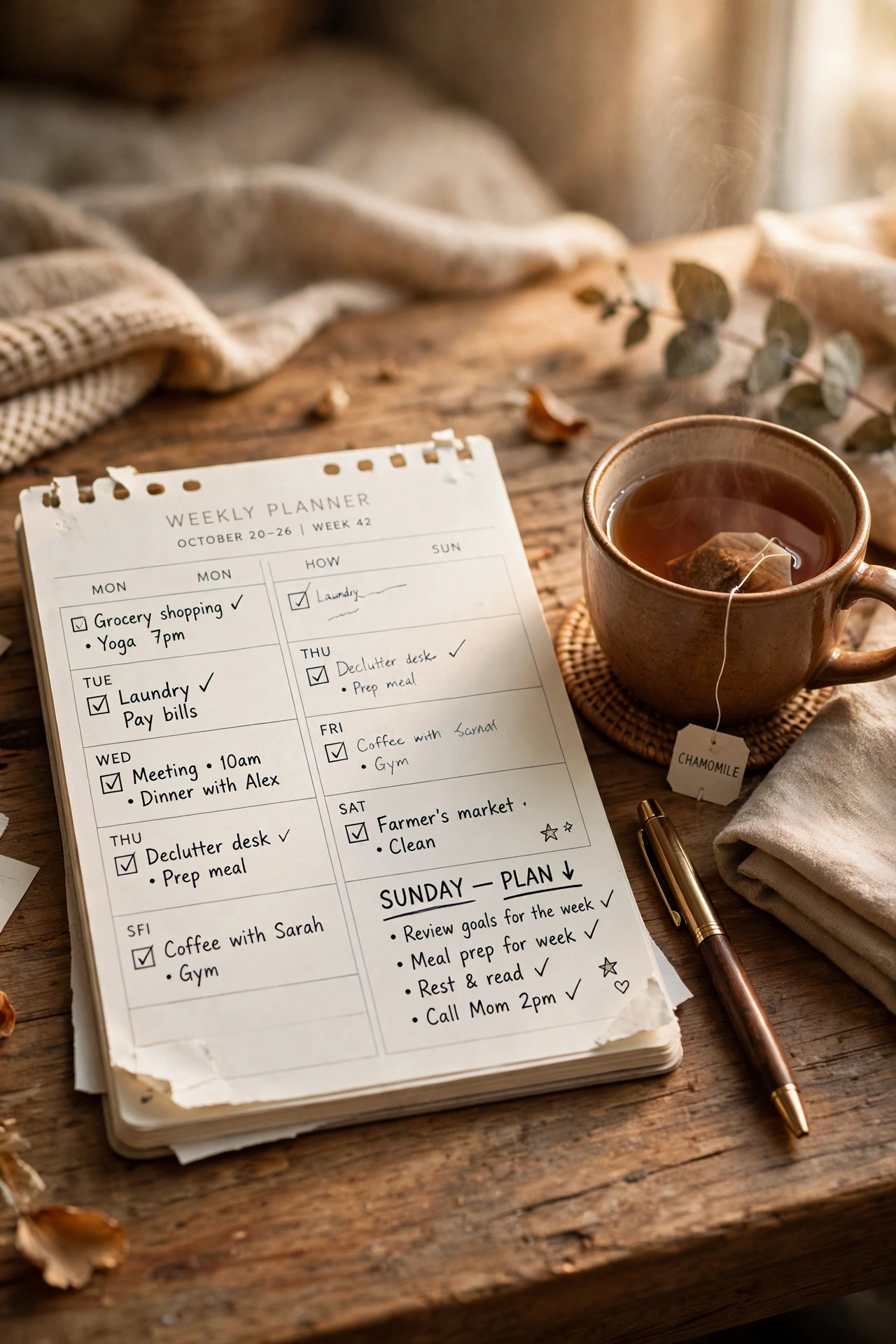
A tear-off weekly planner pad lives on the desk and holds the week’s plan where you can see it all at once. Write the week’s fixed commitments first, then fit tasks around them — it stops the classic mistake of planning tasks for time that doesn’t exist. I plan every Sunday evening with a cup of tea, and the ritual itself has become something I look forward to. Tear off and file the finished weeks if you want a record; I keep a month’s worth as a surprisingly useful diary.
Pro tip: block out lunch and breaks on the pad too, or work will quietly eat them.
Cost: ~$2 · Time: 10 minutes
24. Faux Plant for the Shelf
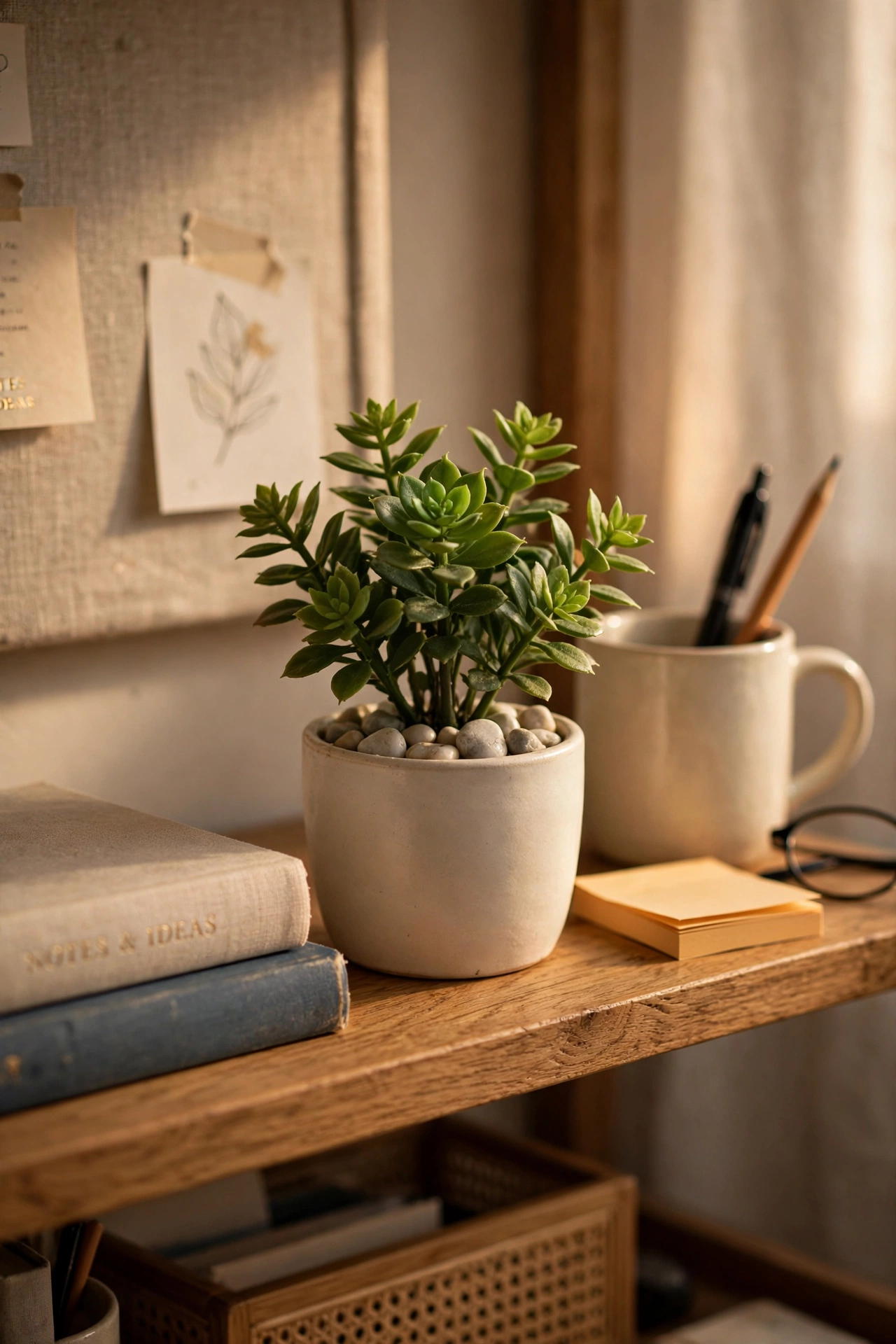
Every office needs something alive-looking, and a small faux plant on the shelf does the job with zero maintenance. Choose one with varied leaf tones rather than flat plastic green — the realistic ones cost the same as the obvious fakes if you look carefully. I have one that’s survived three house moves and still fools visitors from across the room. Dust it quarterly with a damp cloth; a dusty fake plant is worse than no plant at all. (see also: 25-dollar-store-home-office-finds-for-small-spaces)
Pro tip: put a little moss or pebbles on top of the pot’s soil for instant realism.
Cost: ~$3 · Time: 5 minutes
25. Over-Door Hooks for Bags and Headphones
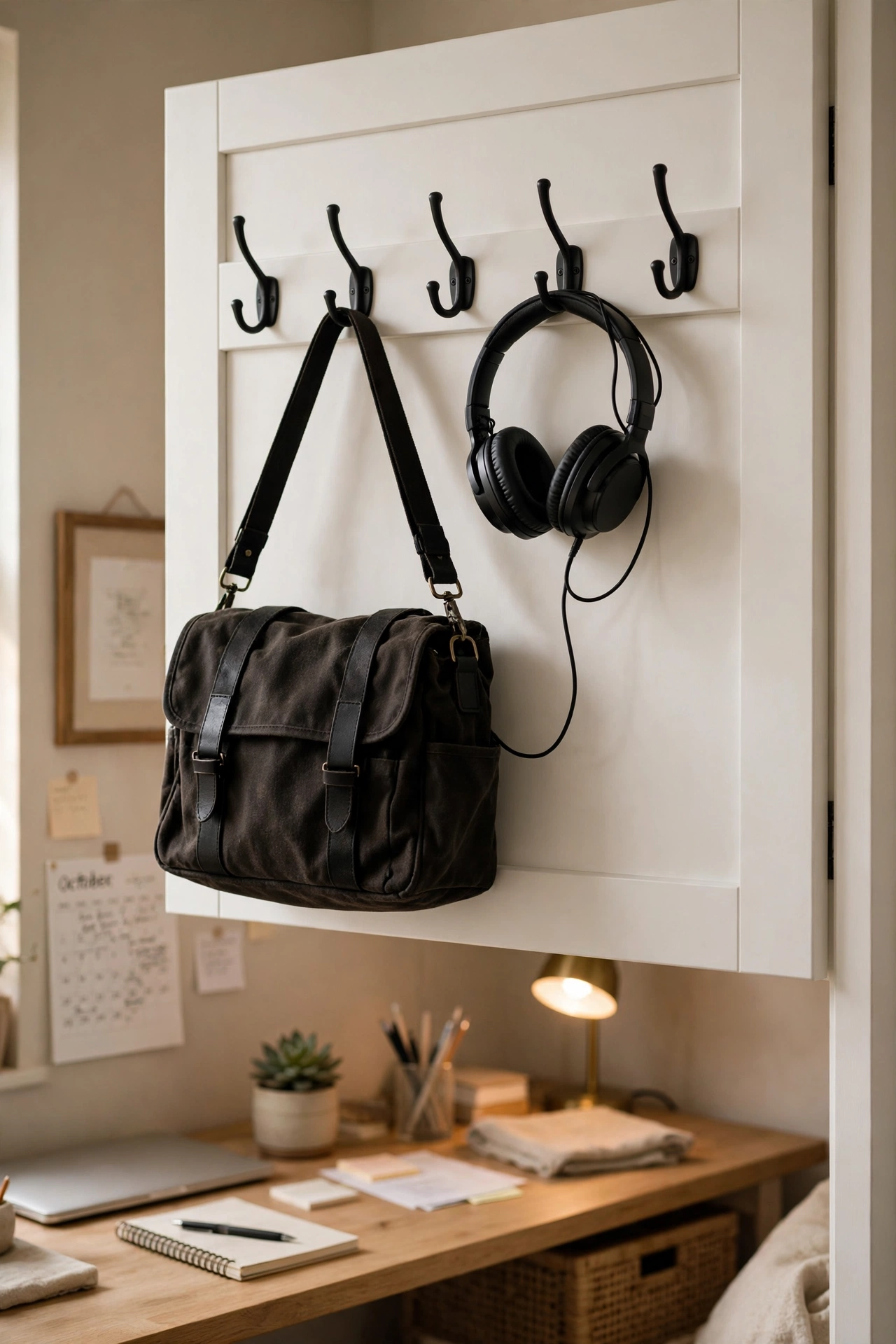
The back of the office door (or cupboard door) is free real estate: a row of over-door hooks holds your work bag, headphones, and a spare jumper. Everything you grab on the way out lives in one spot. I hung mine on the cupboard door beside my desk and my morning routine lost five minutes of hunting. Keep it to three or four hooks so the door still closes properly.
Pro tip: use the top hooks for daily items and lower ones for occasional things, so the door still swings freely.
Cost: ~$3 · Time: 5 minutes
Start with the five finds that solve your biggest annoyance, then add the rest as your system settles in.
Save this idea for later: pin this list and tick off each find as your little office comes together.
